


Blog

If you run a cannabis business, Section 280E is the reason your federal tax bill looks nothing like your actual profit. If you heard that rescheduling ended 280E in April 2026, you heard part of the story. For most operators in Michigan, Illinois, Ohio, and Missouri, it still applies.
The change that took effect on April 28, 2026, was narrow. It covered state-licensed medical marijuana and FDA-approved products containing marijuana. Adult-use cannabis stayed on Schedule I, and so did the tax problem that comes with it.
It also did nothing about the tax you already owe.
280E Changes at a Glance
- Internal Revenue Code (IRC) 280E blocks federal deductions and credits for businesses trafficking in Schedule I or Schedule II substances, leaving the cost of goods sold as the only offset against revenue.
- As of April 28, 2026, state-licensed medical marijuana and FDA-approved marijuana products are considered Schedule III, which puts those activities outside the reach of 280E.
- Businesses holding both medical and adult-use licenses have to divide their expenses between the two, and the IRS has not issued final rules on how to do so as of September 2026.
- Tax assessed for earlier 280E years is still legally owed, and the IRS has actively fought refund claims based on rescheduling.
What Is 280E, and What Does It Do?
Section 280E of the Internal Revenue Code says no deduction or credit is allowed for a business that consists of trafficking in controlled substances listed in Schedule I or Schedule II of the Controlled Substances Act.
It’s just one sentence, but it has governed cannabis taxation for decades. Because all forms of marijuana were classed as Schedule I at the federal level, every state-licensed cannabis business fell under the rule, no matter how carefully it followed state law.
Most businesses pay federal tax on net income, which is what’s left after rent, payroll, insurance, security, and marketing. Cannabis businesses under 280E pay tax on gross profit instead because those operating expenses are disallowed.
The only thing that reduces taxable income is cost of goods sold (COGS), calculated under the inventory rules in Section 471.
Why Dispensaries Get Hit Hardest
COGS captures direct production costs. Under 280E for growers and manufacturers, those business types can capitalize a meaningful share of their labor, materials, and facility costs into inventory, which softens the blow—but retailers can’t. A dispensary’s COGS is mostly what it paid for the product on the shelf, and everything that makes the store run doesn’t count.
Consider a dispensary with $1 million in sales, $600,000 in product cost, and $350,000 in rent, wages, and overhead. Real profit is $50,000, but taxable income under 280E is $400,000.
That’s why cannabis operators fall behind on their federal taxes faster than almost any other industry.
What Changed About the 280E Tax Code in 2026?
On April 23, 2026, the Department of Justice issued a final order moving two categories of marijuana from Schedule I to Schedule III. It took effect with Federal Register publication on April 28, 2026.
The two covered categories are:
- Marijuana contained in an FDA-approved drug product
- Marijuana subject to a state-issued license to manufacture, distribute, or dispense it for medical purposes
You can review the DEA’s published regulatory actions directly here.
Because 280E reaches only Schedule I and Schedule II substances, moving one to Schedule III takes it outside the statute. The Treasury and the IRS confirmed this reading in an announcement the same week.
What Didn’t Change
Adult-use cannabis is still a Schedule I substance. So are unlicensed marijuana crops and bulk marijuana that hasn’t been incorporated into a covered product. The Congressional Research Service summary lays out the boundaries of the order.
A separate DEA administrative hearing on whether marijuana more broadly should move to Schedule III ran from June 29 to July 15, 2026. The transcripts of the hearing have been released as the judge prepares to make a final recommendation to the DEA Administrator, but no decision has been issued at the time of publication.
Even if you’re relying on a broader change, any updates made now aren’t likely to change anything retroactively. More on that below.
Does 280E Still Apply to Your Business?
Your tax burden depends on what your license authorizes, not on what your state allows generally.
| Your License | Federal Schedule as of 4/28/2026 | Does 280E Apply? | What That Means |
|---|---|---|---|
| State medical marijuana license | Schedule III | No, not for that activity | Ordinary and necessary business expenses become deductible on that side of the business |
| Adult-use (recreational) license | Schedule I | Yes | Cost of goods sold remains the only offset |
| Both medical and adult-use | Split | Yes, to the adult-use portion | Shared expenses have to be divided between the two activities |
| FDA-approved product containing marijuana | Schedule III | No | Treated like any other Schedule III business |
In states like Kentucky, Nebraska, and Pennsylvania, which have licensed medical cannabis but not adult-use, operators fall cleanly on the relief side of these reforms. But in states where recreational marijuana is permitted—like Michigan, Illinois, Ohio, and Missouri—many operators hold both license types.
If you’re in that second group, expense allocation is now your central federal tax question. There is no shortcut, and the window for the IRS to release official guidance before the 2026 tax season opens has narrowed to the point that many operators could be left scrambling come January 2027.
Your State Return Is a Separate Calculation
Federal treatment is only half the answer. States decide independently whether to follow 280E accounting, and across the states where we handle the most cannabis-related tax matters, they land in three different places.
| State | State treatment of 280E |
|---|---|
| Michigan | Decoupled. Licensed establishments deduct ordinary business expenses on the state return |
| Illinois | Decoupled. A subtraction covers deductions disallowed federally, for both adult-use and medical licensees |
| Missouri | Decoupled. The Marijuana Business Deduction applies to taxpayers licensed under Article XIV |
| Pennsylvania | Decoupled for corporate net income tax, and the personal income tax never followed 280E |
| Ohio | Follows federal treatment |
| Kentucky | Follows federal treatment |
| Iowa | Limited medical cannabidiol program only; currently unresolved |
| Indiana, Wisconsin, Nebraska | No licensed commercial cannabis market |
If you operate in more than one of these states, your returns have been diverging for years, and the direction of that divergence just changed. Have each state calculated separately rather than derived from the federal number.
Either Way, You Still Owe the Tax From the 280E Years
Here’s the thing—will this change provide relief for many small businesses? Absolutely (if it survives the current legal challenges already being brought against it). But will it change anything about the back taxes you already owe? Unfortunately not.
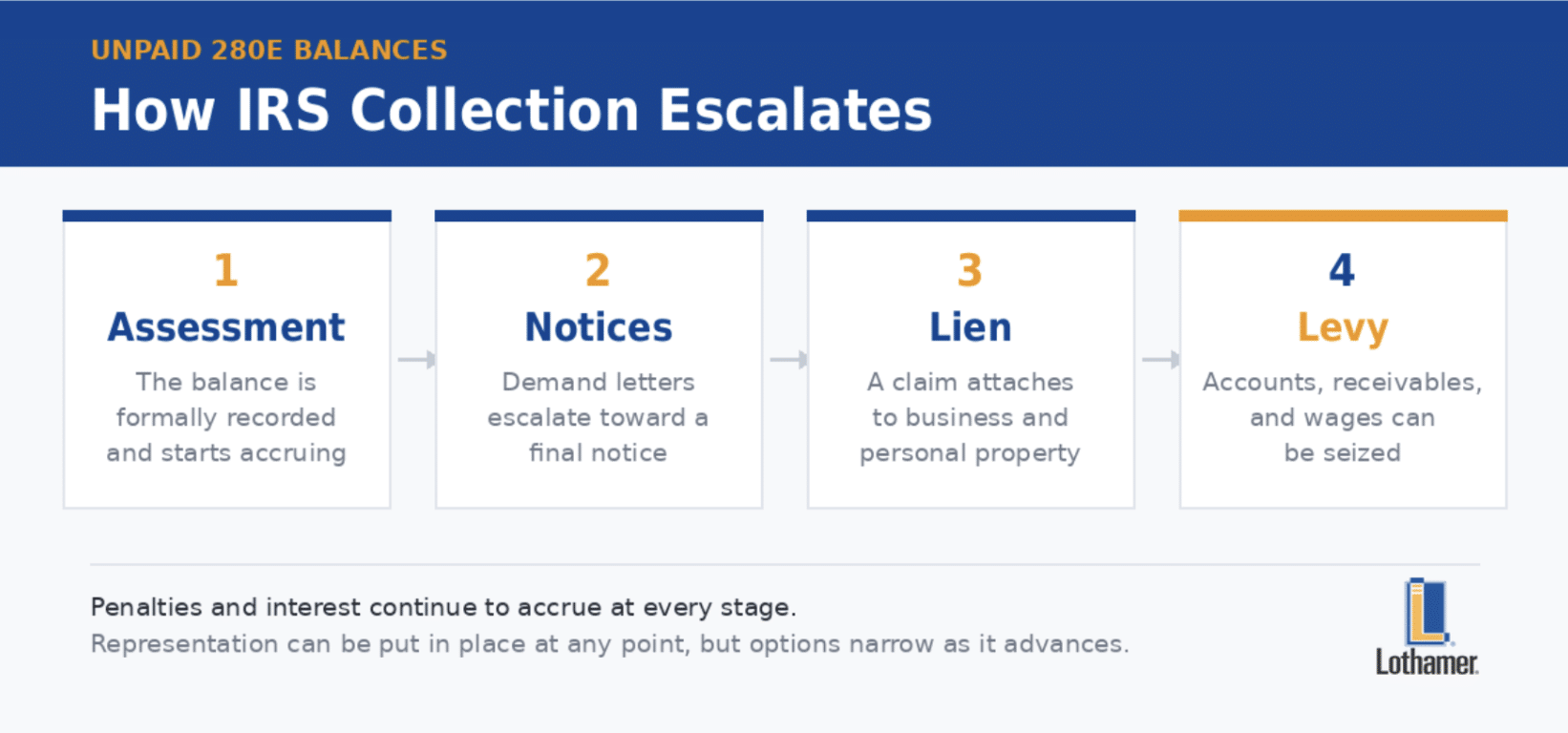
Rescheduling changed the rule going forward, but it didn’t erase assessments from earlier years. If the IRS assessed tax against your business for 2021, 2022, or 2023 under 280E, that balance is still a collectible debt that accrues penalties and interest every day it goes unpaid. The IRS can still come after you with federal tax liens, bank levies, and wage garnishments.
Worse still, 280E creates a structural cash shortage: you owe federal tax on money you never kept. Businesses in that position commonly reach for the one pot of cash already sitting in the operating account, which is withheld payroll tax. That’s a serious problem that has landed many a cannabis business owner in hot water, both professionally and personally.
If You Own a Pass-Through, the Debt Follows You
Most cannabis businesses are structured as LLCs or S corporations. That means the tax flows to the owner’s personal return, and so does the liability.
If your business shuts down, that’s not the end of it. The IRS can pursue the individual owner for the assessed balance, including through levies against personal accounts and wages.
Why Filing Amended Returns on Your Own Backfires
Every cannabis operator has asked the same question since April: Can I go back and claim the deductions I was denied?
The April order encouraged the Treasury to consider retrospective relief for years in which a business operated under a state medical license. As of the time of writing, the Treasury had not adopted any such policy.
Meanwhile, the IRS publicly stated in 2024 that cannabis businesses filing amended returns to claim 280E relief were not entitled to refunds and that those claims were not valid, and it continued arguing that position in Tax Court through 2026.
Filing an aggressive amended return invites an examination without a rule to stand behind. The refund window itself is also finite. Under Section 6511, a claim generally has to be filed within three years of filing the return or two years of paying the tax, whichever is later.
There are ways to preserve that window without forcing a fight, including a protective claim. Which approach fits depends on your exposure, your open years, and whether you’re already under examination. That’s a decision to make with a licensed tax professional.
PRO TIP: Separate your medical and adult-use records now, before year-end, and document the method you used. If you hold both licenses, the first thing an examiner will ask is how you divided shared costs.
What to Do About 280E Cannabis Rules Right Now
You don’t have to wait for official guidance to get a head start on 2026 tax planning.
- File any unfiled returns. Non-filing is the fastest way to lose control of the outcome. The IRS can prepare a substitute return for you, and it won’t include anything in your favor.
- Confirm what your licenses authorize. Pull the paperwork so that you’re sure you’re aligned with what the federal statutes allow.
- Separate medical and adult-use activity in your books. Track inventory, labor, and space by activity, and apply the same method consistently.
- Get representation in place before you respond to anything. An audit notice, collection action, or refund denial has a short response window, and what you say early shapes the whole case.
The Window That Matters Is Yours, Not Washington’s
Rescheduling changed the rule going forward for part of the cannabis industry. It didn’t reach backward, and the IRS has treated the 280E years as fully collectible. Waiting for a policy change that may never apply to your open balances only lets penalties and interest keep building.
The operators who come through this in decent shape will be the ones who get their filings current and their exposure measured while there’s still room to negotiate a resolution. The ones who wait will be negotiating after a levy instead of before one.
Whatever your license says, the balances and the unfiled returns are a problem you can start solving today.
Don’t wait for the IRS to make the next move. Call now and get same-day tax help.
GET REAL, SAME-DAY TAX HELP BEFORE THE NEXT DEADLINE PASSES.
If you’ve received an IRS notice or a lien has already been filed against your property, waiting is the most expensive move you can make. Call or text Lothamer today, and let’s start taking your future back.
📞 (877) 955-9020
📧 [email protected]
🕗 Open 8:00 am – 5:00 pm
¡Llama ahora, hablamos español!
Related Posts


"*" indicates required fields