

Blog

Your card was declined at checkout, or your bank called about a hold you didn’t expect. If the IRS is behind it, that means you’re dealing with an IRS bank levy, and the money in your bank account is frozen. It isn’t gone yet—but it could be very soon.
If you’ve owed money to the IRS for a while, a frozen account can feel like the IRS has run out of patience. It’s a serious step, but it comes with firm rules and deadlines, and those work in your favor when you act quickly.
Federal law makes your bank wait 21 calendar days before sending the money to the IRS. That window exists so you can contact the IRS, arrange to pay, or point out errors in the levy. Here’s what a levy can take, what comes first, and how to request a release.
Quick Facts About IRS Bank Levies
- An IRS bank levy freezes the money in your account the moment your bank receives it, and the bank holds those funds for 21 calendar days before sending them to the IRS.
- The levy reaches only what’s on deposit that day, up to the amount on the levy. Later deposits aren’t affected unless the IRS serves another levy.
- The IRS must send a Final Notice of Intent to Levy at least 30 days before levying, and that notice gives you the right to request a hearing.
- The IRS is required to release a levy in specific situations, including a qualifying installment agreement or economic hardship. A release doesn’t erase the tax debt.
- A bank levy is a one-time seizure, a wage levy is continuous, and a tax lien is a legal claim rather than a seizure.
Note: This guide covers levies by the IRS and state tax agencies. A private creditor with a court judgment follows a different process with different rules.
What Is an IRS Bank Levy?
An IRS levy permits the legal seizure of your property to satisfy a tax debt. A bank levy is the version that targets money in a bank, credit union, or other financial account.
The IRS can levy any property or right to property you have, including property subject to a federal tax lien, unless the tax code exempts it. Beyond bank accounts, levies can garnish wages and take vehicles, real estate, and other personal property.
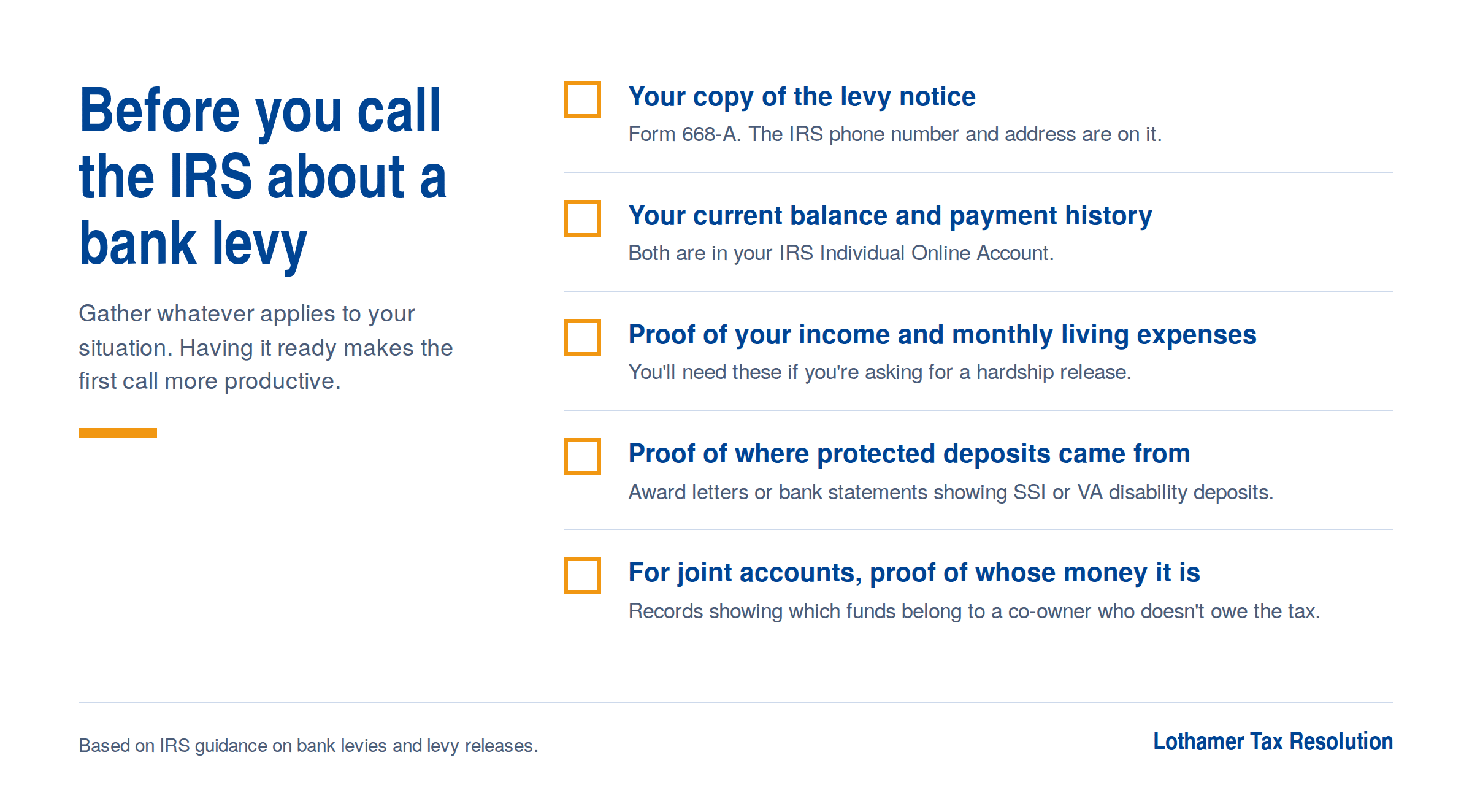
When the IRS levies your account, your bank receives the notice of levy, and you get a copy called Form 668-A. Keep it. You’ll need the phone number and address on it later.
Is an IRS Bank Levy Different From a Creditor’s Bank Levy?
Yes. A credit card company or other private creditor generally needs a court judgment before it can levy your account. The IRS uses its own levy authority under the Internal Revenue Code, with its own rules on notices, deadlines, and protected funds.
What Notices Come Before an IRS Bank Levy?
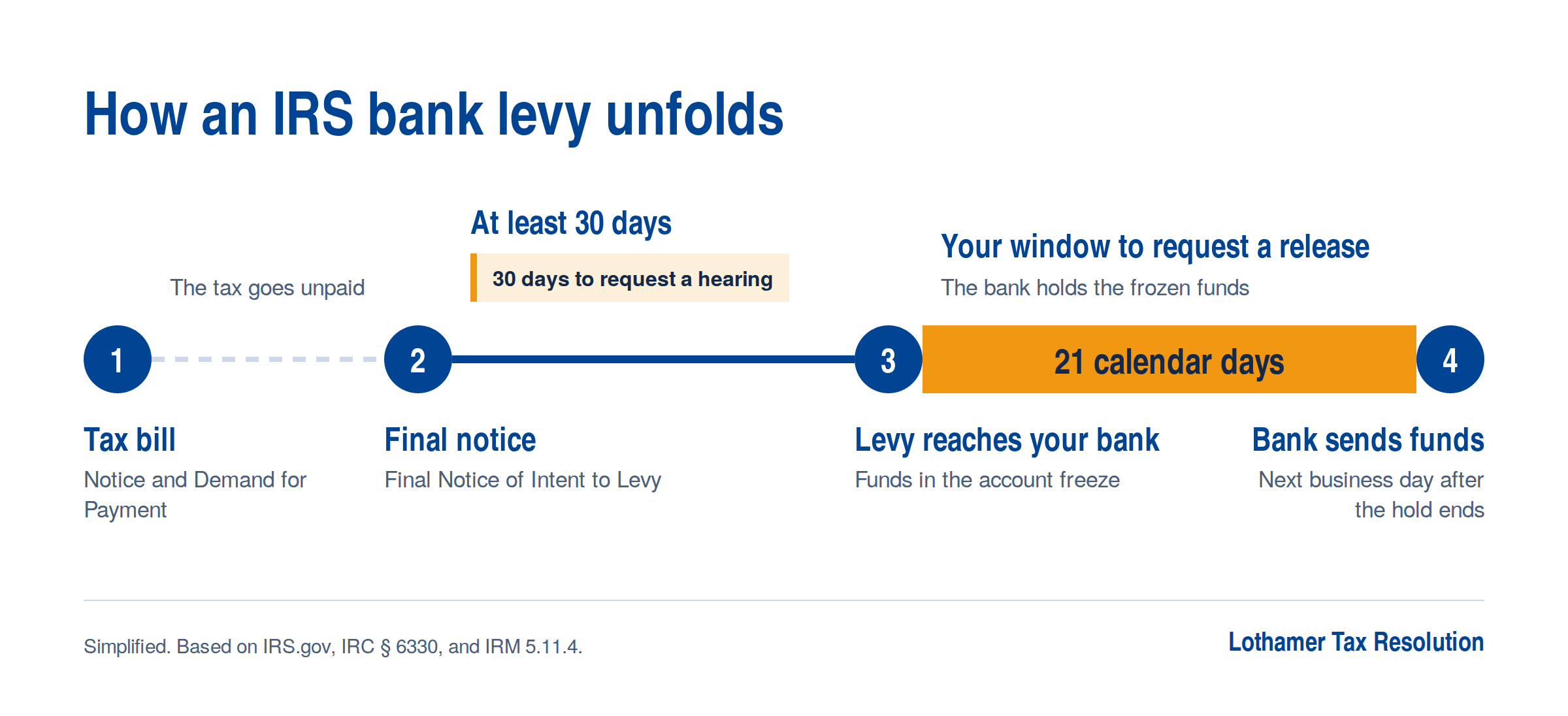
A bank levy shouldn’t be the first time you hear from the IRS. The IRS usually levies only after four requirements are met:
- The IRS assessed the tax and sent you a bill, called a Notice and Demand for Payment.
- The tax went unpaid.
- The IRS sent a Final Notice of Intent to Levy and Notice of Your Right to a Hearing at least 30 days before the levy.
- The IRS sent an advance notice that it may contact third parties about your tax liability.
That final notice is the one to watch. Federal law requires it at least 30 days before the first levy for that tax period. The notice must also explain your appeal rights and the alternatives that could prevent a levy.
If you’re reading this before a levy, you may still be inside that 30-day window, which gives you more options (covered below). Our guide to IRS and state collection notices explains what the earlier letters mean.
What Happens During the 21-Day Holding Period?
IRS levies are usually delivered by mail. The date and time your bank receives the notice becomes the levy date. At that moment, the levy freezes the funds in your account. Money you deposit afterward normally isn’t affected.
The bank holds those frozen funds for 21 calendar days. If no release arrives, the bank remits the money on the next business day after the holding period ends, with no additional notice to you.
Those 21 days are your time to act. Calling the IRS, documenting immediate economic hardship, and setting up a resolution all need to happen before the bank sends the money.
What Happens After the Money Reaches the IRS?
The IRS applies levy proceeds to your balance, generally starting with the oldest tax owed, and you can’t choose how they’re applied. If the money shouldn’t have been taken, you can file a claim to have it returned and appeal a denial.
However, success can be hard to come by. In most cases, once that money is gone, it’s gone—so the time to act is now.
How Much Can a Bank Levy Take?
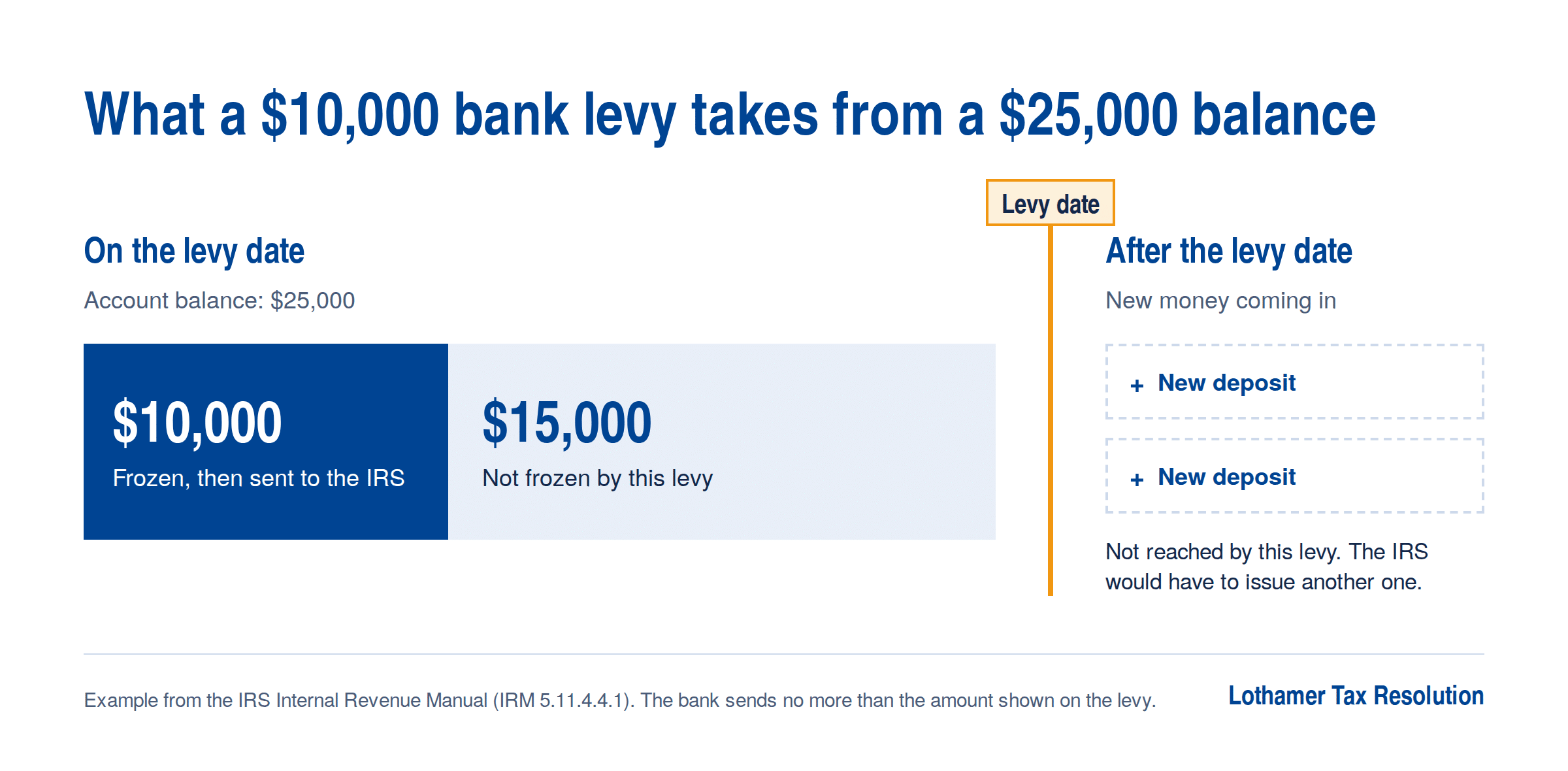
A bank levy can take everything in the account when it arrives, up to the amount shown on the levy. If the levy is for $10,000 and you have $25,000 in the bank, only $10,000 is frozen and sent to the IRS.
If your balance is smaller than the levy amount, the bank sends what’s there, plus any interest the account earns during the holding period.
How Often Can the IRS Levy My Bank Account?
Each bank levy is a one-time seizure. It reaches only what’s on deposit when the bank receives it, so later deposits, including those made during the holding period, aren’t taken unless the IRS issues another levy.
That said, a second levy is a real possibility, especially if your bank balance can’t cover the full debt. The IRS says a released levy doesn’t erase what you owe, and a new levy may follow if you don’t make arrangements to resolve the balance.
Can the IRS Levy a Joint Bank Account?
Yes. If you have an unrestricted right to withdraw from an account, a levy can reach it, even when someone else made every deposit. The Supreme Court upheld the IRS’s levy on a joint checking and savings account in United States v. National Bank of Commerce (1985).
A co-owner who doesn’t owe the tax still has options. If their own money sits in the same account, the IRS suggests calling the number on the Form 668-A and being ready to prove the funds are theirs.
If the money has already gone to the IRS, the co-owner can file an administrative wrongful levy claim within two years from the date on the notice of levy.
Is Any Money in My Account Protected From an IRS Levy?
Less than most people expect. The protections that apply to creditor garnishments mostly don’t apply when the IRS is collecting, because the tax code exempts only a short list of property.
| Type of money | Protected from an IRS bank levy? |
|---|---|
| Social Security benefits (retirement and survivors) | No. The tax code overrides Social Security's usual protection, and the IRS can also take 15% of each monthly benefit through the Federal Payment Levy Program. |
| Supplemental Security Income (SSI) | Yes. SSI is exempt from levy by law. |
| Service-connected VA disability benefits | Yes. These benefits are exempt from levy by law. |
| Wages after they're deposited | No. Once income is in the bank, there's no exempt amount, though a levy on a full paycheck may qualify for a hardship release. |
| Automatic two-month bank protection for federal benefits | No. The Treasury rule covers orders from courts, states, and local governments, not IRS levies. |
The Federal Payment Levy Program is a separate tool from a bank levy. If your federal payments have been levied, the IRS lists who to call on its federal and state levy programs page.
If the frozen money is SSI or VA disability, or the levy took a full paycheck you need for living expenses, contact the IRS right away. Have award letters or bank statements ready that show where the deposits came from.
Bank Levy vs. Wage Garnishment vs. Tax Lien: What’s the Difference?
These three get confused constantly, but the difference changes what you should do next. A levy takes property, while a lien is a legal claim that secures the debt.
| Bank levy | Wage levy (wage garnishment) | Tax lien | |
|---|---|---|---|
| What it is | A one-time seizure of money in your account | A continuous seizure of part of each paycheck | A legal claim against your property |
| Does money leave your hands? | Yes, after the 21-day hold | Yes, every pay period | Not by itself |
| Is any amount exempt? | Only listed property, such as SSI | Yes, a portion of your wages | Doesn't apply |
These aren’t three options the IRS picks between. A federal tax lien arises automatically when the IRS sends its first bill and the tax isn’t paid in full, so a lien already exists by the time a levy arrives. The IRS may also file a public Notice of Federal Tax Lien to alert your creditors.
Levies come later, after the final notice and the 30-day window. Because a released levy doesn’t erase the balance, resolving the debt itself is what keeps another levy from following.
If wage levies are your bigger worry, see our guide on how to stop wage garnishment. For a closer look at how tax liens attach to your property:
How to Stop or Release an IRS Bank Levy
Contact the IRS immediately at the number on your copy of the levy. The IRS can grant a levy release once you resolve the tax liability or if the levy causes an immediate economic hardship. If the IRS turns you down, you can appeal.
Before you call, log in to your IRS Individual Online Account. It shows how much you owe and your payment history, and it’s where you can view your tax records, including your IRS account transcript.
Can You Stop an IRS Bank Levy Before It Happens?
In most cases, yes, if you act within 30 days of the final notice. Filing Form 12153 by that deadline requests a Collection Due Process (CDP) hearing with the IRS Independent Office of Appeals.
A timely request pauses the proposed levy while the hearing and any appeal are pending. It also pauses the collection statute of limitations, so the clock on how long the IRS can collect stops running during that time.
At the hearing, you can raise collection alternatives such as an installment agreement or an offer in compromise. If you disagree with the outcome, you can file a Tax Court petition within 30 days of the determination.
If you miss the 30-day deadline, you can still request an equivalent hearing within one year of the notice date. Tax Court review is only available after a timely collection due process appeal, which is one more reason to act within the 30 days.
When Does the IRS Have to Release a Levy?
The IRS is required to release a levy if it determines that:
- You paid the amount you owe.
- The collection period ended before the levy was issued.
- Releasing the levy will help you pay your taxes.
- You entered an installment agreement whose terms don’t allow the levy to continue.
- The levy creates an economic hardship.
- The property is worth more than you owe, and releasing it won’t hinder collection.
Economic hardship has a specific meaning here: the levy leaves you unable to pay reasonable, necessary living expenses. When a levy takes an entire deposited paycheck, the IRS manual directs employees to grant a full or partial release, as appropriate, to avoid that hardship.
If the levy has left you in financial hardship, a hardship release depends on what you can document. Gather proof of your income and monthly expenses before you call. A release ends the levy, but the balance remains. You’ll still need a resolution, such as a payment plan through installment agreements or obtaining currently not collectible status when you truly can’t pay.
How Long Does It Take to Release a Bank Levy?
The IRS doesn’t publish a standard timeline. What matters is that a bank levy release reaches your bank before the holding period ends, because the bank must send the funds if no release arrives.
That’s why the first few days count. Once you engage a licensed tax professional at Lothamer, we can immediately request a stay on collection while we work toward a resolution. No weeks of waiting around for an electronic request to make its way through the system.
What If the IRS Levied Your Account by Mistake?
If the IRS caused the levy by mistake, you may be reimbursed for bank charges. File Form 8546 at the IRS address on your copy of the levy within one year of the charge. Claims are capped at $1,000.
To qualify, the IRS must have caused the error, you can’t have contributed to it, and you must have responded to IRS contacts on time before the levy.
Do State Tax Agencies Levy Bank Accounts Too?
State tax agencies have their own levy powers and run their own collections process. Michigan’s Department of Treasury, for example, says it may levy against assets held by a third party. Notices, deadlines, and appeal rights vary by state, so the federal rules above don’t automatically carry over.
At Lothamer Tax Resolution, we represent clients with state tax problems in Michigan, Ohio, Indiana, Illinois, Wisconsin, Kentucky, Pennsylvania, Missouri, Iowa, and Nebraska.
What to Do Next If the IRS Levied Your Bank Account
A bank levy is the most abrupt step the IRS takes, and it comes with the clearest deadline. You know how long you have, what the levy can reach, and which situations require the IRS to release it. But to make sure you take the best possible path for your financial future, you can always count on the licensed tax professionals at Lothamer. We’re here to Set You Free from overwhelming tax problems.
ACCOUNT FROZEN BY AN IRS BANK LEVY? GET HELP NOW!
Call Lothamer for Same-Day Tax Help When & Where It Matters.
📞 (877) 955-9020
📧 [email protected]
🕗 Open 8:00 am – 5:00 pm
¡Llama ahora, hablamos español!
Lothamer Tax Resolution: Proudly Serving the Midwest & Beyond
Lothamer Tax Resolution has represented taxpayers since 1978. Our Enrolled Agents and licensed tax professionals build a Roadmap to Resolution® around your situation, from bank levies and wage garnishment to unfiled tax returns.
We offer interest-free financing with no large upfront retainer, so cost doesn’t have to stand between you and the help you need.
Related Posts


"*" indicates required fields